Outboard engine maintenance
Flushing, changing the oil and plugs, and protecting an outboard step by step.
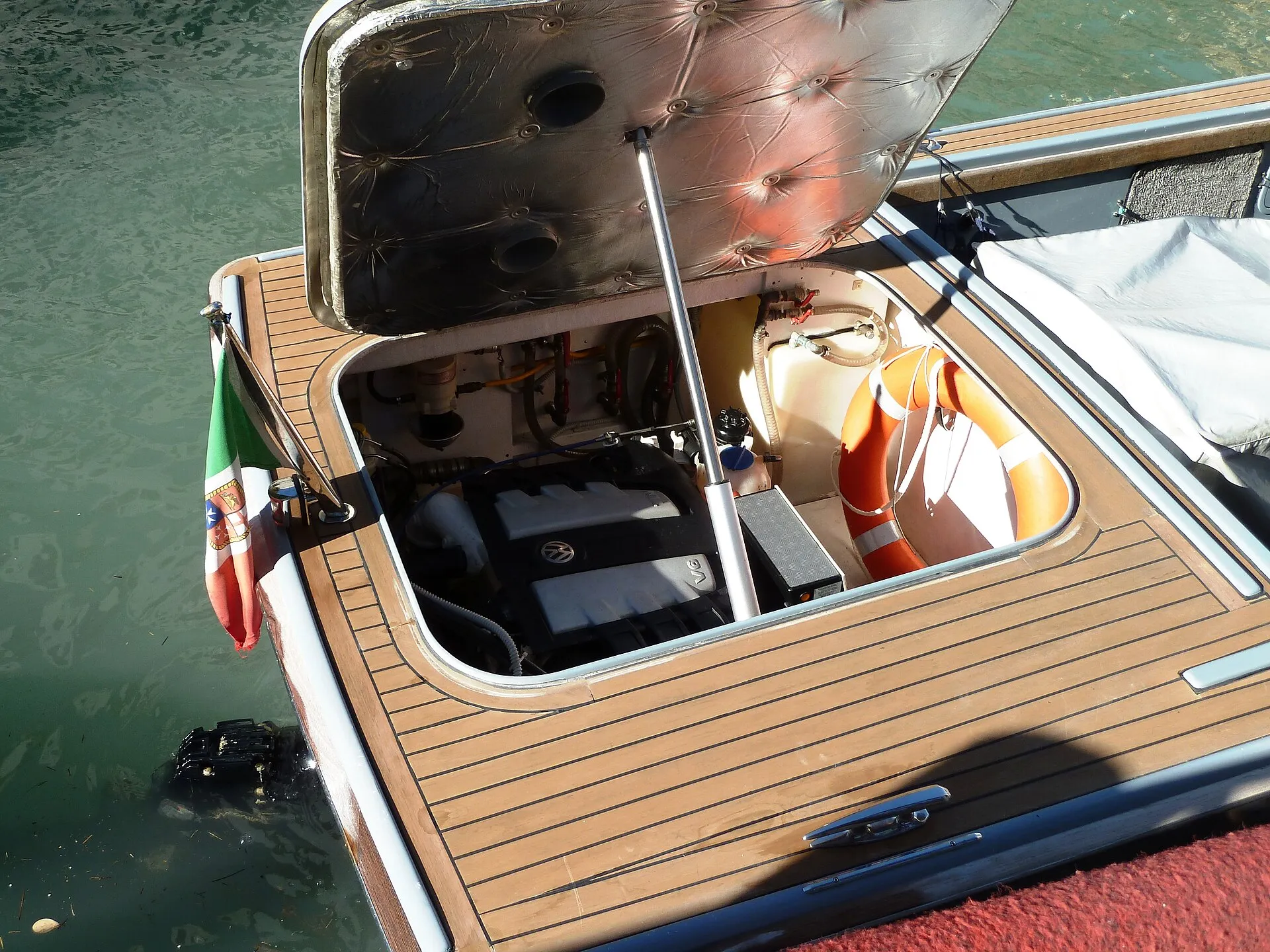
An outboard spends its life in the harshest environment imaginable — between salt water, damp and vibration. Regular maintenance is not a luxury but the condition of reliability and safety afloat. Most failures come from a neglected cooling system and old fuel. Start the service plan by reading the manual for your particular model, because the intervals differ between makers and between two- and four-stroke versions.
After every outing in salt water the engine has to be flushed with clean fresh water. The easiest way is a set of muffs over the cooling water intake, or a dedicated flushing connection if the engine has one. Run the engine at idle for 5–10 minutes, watching the tell-tale stream — its absence means a blocked system or a worn pump impeller. Flushing removes the salt and deposits that otherwise crystallise in the cooling passages and lead to overheating.
The water pump impeller is a wear part — the rubber vanes lose their flexibility and crack. On engines used at sea it is usually replaced every season or every 100 engine hours, and as a precaution whenever the tell-tale stream weakens. When changing it, check the state of the wear plate and the housing, and fit the vanes bent in the direction of rotation. Remember to count the pieces of the old impeller — broken fragments can block the thermostat passages.
Change the oil in a four-stroke as recommended, most often every 100 hours or once a season, using oil to the FC-W (NMMA) specification intended for marine engines. Change the oil in the gearbox (the leg) too — a milky, pale colour in the gear oil means water is getting in through damaged seals, which has to be repaired before you go out again. The oil filter and fuel filter (including the water separator) are changed with the oil. On two-strokes, keep an eye on the quality of the mixture oil or the injection system.
Assess the spark plugs by the deposits and the colour of the insulator and set the electrode gap as the manual says. Zinc anodes (or magnesium in fresh water) protect the engine from galvanic corrosion — replace them once about half the material is gone. Look over the propeller too, clear any line wound round the shaft and check the nut and split pin. Grease the lubrication points (joints, trim mechanism, propeller shaft) with waterproof marine grease.
Before laying up for the winter, carry out long-term preservation: drain or stabilise the fuel, fog the combustion chamber with preserving oil, and drain the cooling system completely to avoid it being split by freezing water. Store the engine upright, so that water runs out of the leg. Disconnect the battery and top it up periodically. In spring, reverse the procedure: check the fuel, charge the battery and do a test start with flushing.
While working, always observe safety: never run the engine without cooling water (not even for seconds), because the pump impeller is destroyed when run dry. Work in a ventilated place away from sources of ignition, and clear up any spilt fuel at once. Disconnect the plug caps before working on the propeller, to rule out an accidental start. Take used oil and filters to a waste collection point — pouring them into the water is an environmental offence.
Material prices — products and options
Indicative prices in EUR (incl. VAT), as of July 2026. Products widely available in Europe; prices depend on the shop, the pack size and consumption. The links lead to example shops that ship across the EU. Dollar amounts are converted at 1 EUR = 1.1622 USD (ECB, 7 September 2026) and rounded — treat them as a rough guide, not a price in a US shop. Imperial values in brackets are conversions of the metric figure.
Marine engine oil (four-stroke FC-W) and two-stroke mixture oil
- Quicksilver — 4-Stroke Marine Oil 10W-30 / 10W-40 FC-W
semi-synthetic oil for four-stroke outboards, 1 l (0.3 US gal) bottle€15–22 (≈$17–26) approx. - Quicksilver — 4-Stroke 25W-40 Synthetic Blend
all-purpose FC-W oil for every four-stroke outboard, 1 l (0.3 US gal)€16–24 (≈$19–28) approx. - Yamalube — 4-M 10W-30 / 10W-40 FC-W
oil made for Yamaha four-stroke engines, 1 l (0.26 US gal, premium)€18–28 (≈$21–33) approx. - Quicksilver — Premium Plus 2-Stroke TC-W3
oil for the mixture / oil injection in two-stroke engines, 1 l (0.3 US gal)€12–18 (≈$14–21) approx.
Gear oil for the leg + sealing washers
- Quicksilver — High Performance Gear Lube SAE 90
oil for the leg gearbox, 1 l (0.3 US gal) bottle / 250 ml (8 fl oz) tube€15–24 (≈$17–28) approx. - Yamalube — Gear Oil SAE 90 GL-4
gear oil for Yamaha legs, 1 l (0.3 US gal)€14–22 (≈$16–26) approx. - Mercury / Quicksilver — set of sealing washers for the plugs
aluminium washers for the drain / filler screws, set€3–8 (≈$3–9) approx.
Water pump impeller with gaskets
- Johnson / Jabsco — water pump impeller
neoprene impeller, version to suit the engine model (budget)€10–25 (≈$12–29) approx. - Mercury / Quicksilver — Water Pump Repair Kit
complete kit: impeller, plate, gaskets, O-rings€25–55 (≈$29–64) approx. - Yamaha — original impeller / water pump kit
OEM for Yamaha engines, by model (premium)€20–60 (≈$23–70) approx.
Oil filter + fuel filter / separator
- Mercury / Mariner — four-stroke oil filter 25–115 HP
spin-on filter for four-stroke outboards€12–18 (≈$14–21) - Yamaha — fuel filter (in-line / element)
in-line fuel filter or element depending on the model€8–20 (≈$9–23) approx. - Racor — fuel/water separator with element
separator with a 10 µm filter, housing + element (premium)€30–70 (≈$35–81) approx.
Spark plugs + feeler gauge
- NGK — spark plug for outboards
for Mercury F2.5–20 / Tohatsu / Suzuki DF and the like, each€4–10 (≈$5–12) approx. - Champion — marine spark plug
equivalent for outboard engines, each€3–8 (≈$3–9) approx. - Feeler gauge / spark plug gap gauge
set of blades for setting the gap€5–12 (≈$6–14) approx.
Zinc / magnesium anodes
- Zinc anode — Mercury / Mariner 6–15 HP
leg anode for small outboards (budget)€7–13 (≈$8–15) - Zinc anode — Mercury 40 HP four-stroke
leg anode for medium outboards, each€25–43 (≈$29–50) - Tecnoseal / Martyr — zinc or magnesium anode (fresh water)
Zn version (sea) or Mg (inland) depending on the model€8–40 (≈$9–46) approx.
Waterproof grease + preserving spray (fogging oil)
- Waterproof marine grease
grease for the shaft, leg locks and joints, tube / tin€8–16 (≈$9–19) approx. - Quicksilver — Storage Seal / Corrosion Guard (fogging)
spray for fogging the cylinders for winter storage, 340 g (12 oz)€14–22 (≈$16–26) approx. - Corrosion X — anti-corrosion / penetrating spray
protection for contacts, hardware and the inside of the engine, aerosol (premium)€18–28 (≈$21–33) approx.
Flushing muffs + fuel stabiliser
- Engine flushing muffs (round)
fresh water connection with a Gardena adapter€18–22 (≈$21–26) - Flushing kit for Mercury / Mercruiser
flushing adapter for the Mercury leg€14–18 (≈$16–21) approx. - LIQUI MOLY / STA-BIL — marine fuel stabiliser
protects fuel from ageing, 500 ml (17 fl oz) (for about 100 l (26.4 US gal))€12–18 (≈$14–21)