Exhaust system and waterlock — checking and repair
How a wet exhaust with a waterlock works and how to check hoses, clamps and the anti-siphon loop to keep water out of the engine.
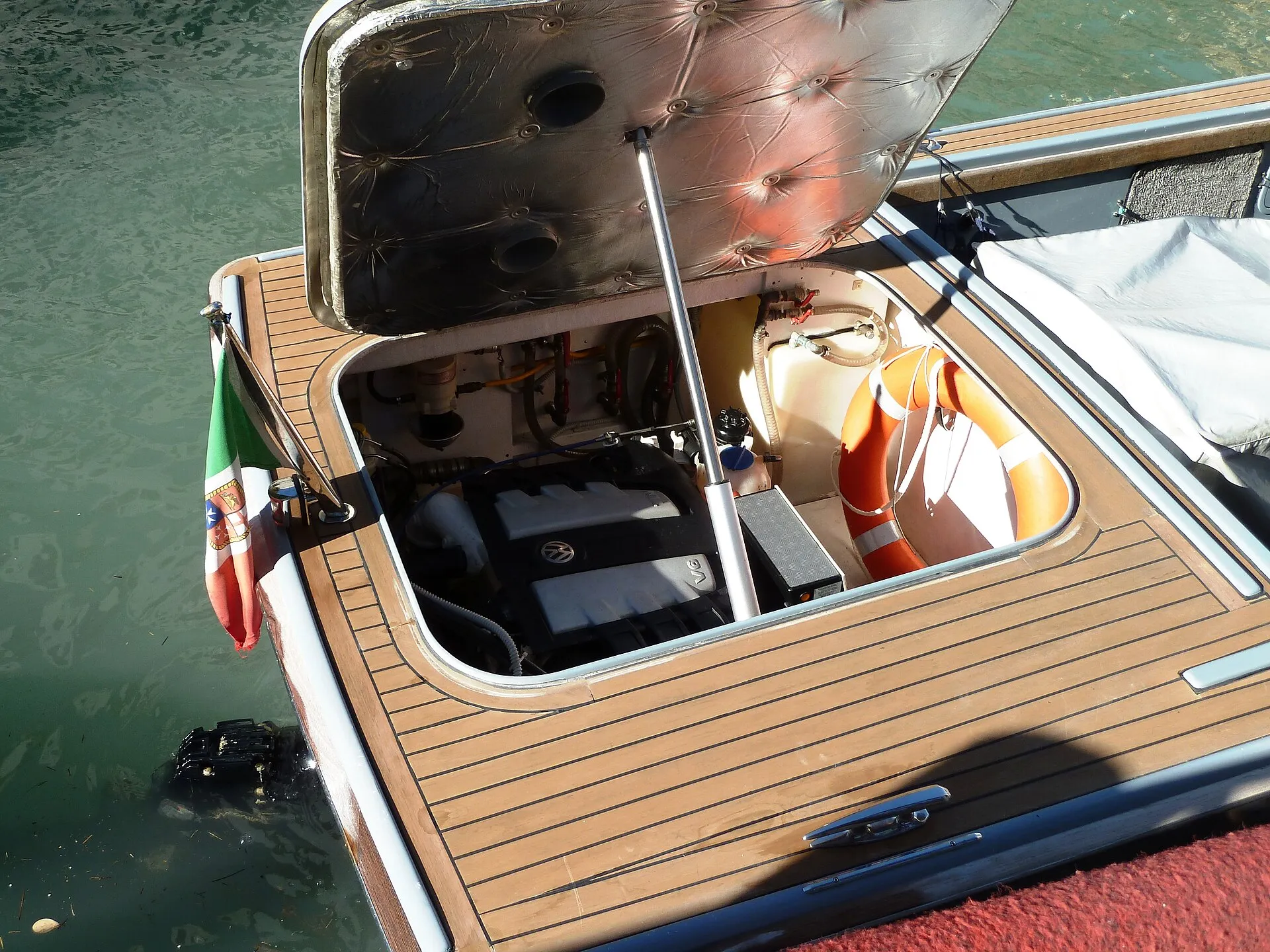
Most marine engines have a wet exhaust, in which cooling water is injected into the gases just after the manifold. The water lowers the gas temperature, which makes cheaper rubber hoses possible instead of rigid pipes, and at the same time cools and silences the exhaust. The heart of such a system is the waterlock (water separator) — a tank that collects the water between starts and prevents it running back into the engine. Understanding this circuit is crucial, because most serious failures come from water flooding the cylinders.
Start the inspection with the hoses and clamps. The exhaust hose must be made for a wet exhaust (reinforced, resistant to heat and water), not an ordinary garden or fuel hose. Check that it is not hardened, cracked or gone soft, and that there are no signs of leaks around the waterlock. Every joint should be secured with two stainless steel worm-drive clamps, ideally facing opposite ways, tightened firmly but without cutting into the rubber.
Assess the waterlock itself. Plastic tanks crack with age, from knocks and from overheating, and can silt up and foul inside. Empty the standing water out of it before laying up and check for signs of black soot showing it has run dry. If the body is cracked or deformed, replace it with a model of the right capacity and connection diameters — a waterlock that is too small will not hold the water and will pass it on.
The key safeguard is an anti-siphon loop with a vented valve, fitted above the waterline. It stops seawater being siphoned into the engine when the boat is lying still or heeled. Check that the vented valve is not salted up and blocked — take it off, rinse and blow it through, because a blocked valve makes the whole loop useless. A missing or faulty loop is a common cause of hydraulic lock in the engine.
Check the cooling water intake and its injection into the exhaust as well. A blocked raw water filter or a worn pump impeller reduce the flow, so the gases and hoses overheat and harden. The water injection spigot in the manifold often silts up and corrodes, which leads to the manifold overheating and exhaust gases backing up. It is worth changing the impeller and checking the anodes in the heat exchanger while you are there.
After replacing components, do a controlled start. Watch for water coming out of the exhaust with the gases within a dozen or so seconds of starting — no water means shutting the engine down at once and finding out why, because a dry exhaust melts the hoses in minutes. Check every joint for leaks at working pressure and listen for unusual noises. Make sure that no water is dripping and no exhaust gas is escaping into the hull.
Finally, look after the prevention. The exhaust hose and the waterlock have a real service life, and even with no visible damage they are worth replacing after many seasons. When laying up, empty the waterlock and the whole low part of the system, so that frost cannot split it. Keep a record of when hoses, clamps and the waterlock were changed — this is a safety item, and neglecting it ends with water sucked into the cylinders and an expensive engine repair.
Material prices — products and options
Indicative prices in EUR (incl. VAT), as of July 2026. Products widely available in Europe; prices depend on the shop, the pack size and consumption. The links lead to example shops that ship across the EU. Dollar amounts are converted at 1 EUR = 1.1622 USD (ECB, 7 September 2026) and rounded — treat them as a rough guide, not a price in a US shop. Imperial values in brackets are conversions of the metric figure.
Exhaust hose for a wet exhaust
- Vetus — SLANG (rubber hose)
flexible EPDM wet exhaust hose, -30…+100°C (-22…+212°F), cut to length, 30–102 mm (1.18 in–4.02 in) dia. — price per metre€40–90 (≈$46–105) / m (approx.) - Vetus — SLANG40, 40 mm (1.57 in) internal dia.
reinforced spiral hose for the most common leisure boat engines — price per metre€45–65 (≈$52–76) / m (approx.) - Trident — 200 Series Softwall
wet exhaust and cooling water hose, 2–6 ply reinforcement, ozone and salt resistant — price per metre€30–55 (≈$35–64) / m (approx.)
A waterlock of the right capacity and connections
- Vetus — Waterlock Type LP
compact water separator for tight engine bays, rotating spigots, various diameters€100–200 (≈$116–232) - Vetus — Waterlock/Muffler NLPH
waterlock with a silencer for horizontal mounting, rotating hose connections€237–320 (≈$275–372) - Vetus — Dual Stage NLP
two-stage waterlock (two chambers + a riser), better noise damping€202–330 (≈$235–384)
Stainless steel hose clamps
- Stainless worm-drive clamps (W4)
A2 stainless steel, various diameter ranges — price each€2–8 (≈$2–9) / pc - Set of hose clamps for on board
set of stainless clamps in various sizes for emergency replacement€65–90 (≈$76–105) / set - Heavy-duty stainless clamps
wider band, higher tightening torque — for exhaust joints — price each€4–12 (≈$5–14) / pc
Anti-siphon loop with a vented valve
- Vetus — AIRVENTV (vented loop valve)
type V anti-siphon valve with a pressure valve, for 13/19/25/32 mm (1.26 in) hoses€100–110 (≈$116–128) - Vetus — AIRVENTH (with a drain hose)
type H version with 4 m (13.1 ft) of hose led outboard, for 13/19/25/32 mm (1.26 in) hoses€95–105 (≈$110–122)
Water pump impeller and assembly grease
- Johnson Pump — MC97 impeller / 6 blades
nitrile impeller, type 2 (09-808B-1) for common cooling pumps€18–22 (≈$21–26) - Johnson Pump — F4 impeller kit (nitrile)
impeller with seals and O-ring (09-824P-9) for F4 pumps€23–30 (≈$27–35) - Johnson Pump — F4 impeller kit (polyurethane)
more durable polyurethane impeller + assembly grease for a watertight fit€35–40 (≈$41–46)
Raw water filter and intake strainer
- Vetus — cooling water filter Type 140
raw water filter for single- and dual-circuit systems, seawater resistant€75–90 (≈$87–105) - Vetus — cooling water filter Type 330
higher flow up to 330 l (87.2 US gal)/min, for larger engines and boats€91–130 (≈$106–151) - Vetus — spare strainer FTR05 (Type 330)
original strainer element for the Type 330 raw water filter€16–20 (≈$19–23) - Jabsco — 38 mm (1.5 in) intake strainer
strainer protecting the water intake from debris, 38 mm (1.5 in) connection€30–35 (≈$35–41)
Zinc/aluminium anodes for the exchanger
- Engine zinc anodes (pencil)
pencil anode for the heat exchanger, cathodic protection, various threads/lengths€11–20 (≈$13–23) / pc - Set of engine zinc anodes
set of anodes matched to the engine series (Mercruiser, Volvo Penta and others)€42–70 (≈$49–81) / set
Spanners, screwdrivers and an inspection torch
- Screwdriver for hose clamps (stainless)
screwdriver or 7/8 mm (0.31 in) socket for tightening clamps safely — approx.€8–20 (≈$9–23) (approx.) - LED inspection torch (waterproof)
compact workshop torch for checking hoses, the waterlock and the bilge — approx.€15–40 (≈$17–46) (approx.)