Water heater and hot water system on a yacht
Fitting and servicing a yacht water heater: heating from the engine and 230 V, the coil, the safety valve and the thermostatic mixer.
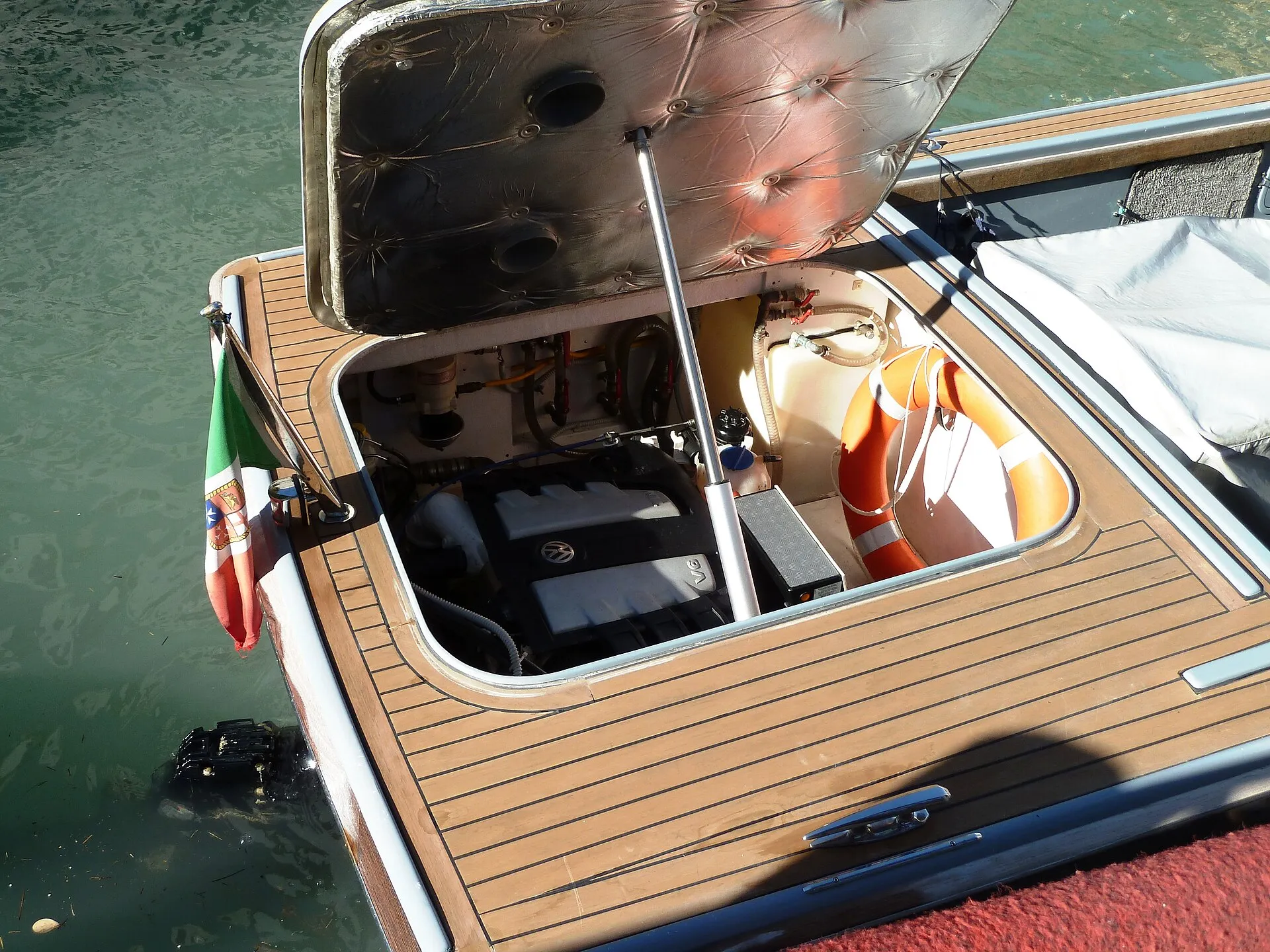
A calorifier is a domestic hot water tank heated most often from two independent sources: a coil in the engine's cooling circuit and a 230 V electric element fed from shore power or an inverter. That way the water heats for free while motoring, and in a marina you use shore power. Understanding both circuits is the basis of both installation and fault-finding. Typical capacities on yachts are 20–40 litres, with insulation to limit heat loss.
The heating coil is plumbed into the engine's coolant circuit — hot fluid from the engine passes through the coil in the tank, giving up its heat to the domestic water. It is connected in parallel, usually to the cooling circuit spigots, using hoses of the right diameter secured with clamps. It is CRITICAL to bleed the circuit properly and to route the hoses so that no air locks form, as they block the flow and can make the engine overheat. After installation, check the coolant level and the engine temperature.
A 230 V electric element demands a rigorous approach to safety. The circuit must be protected by a residual current device (RCD), and the calorifier body and the element properly earthed according to the rules for 230 V installations on boats (ISO 13297). Choose the element's rating to suit the source — on an inverter, the element's power must fit within its capacity. NEVER switch on an element in an empty or unfilled calorifier, as it will burn out immediately.
A pressure relief valve is compulsory. Water expands as it heats, and without relief the pressure would burst the tank or the system — the valve opens at its set pressure and releases the excess. Fit it as the instructions say, directing any discharge somewhere safe (the bilge or a sink), and never blank it off. It is also worth having a non-return valve in the system to stop hot water flowing back into the cold side and, optionally, an expansion vessel to stabilise the pressure.
A thermostatic mixing valve is a comfort and safety item worth not skipping. Water heated by the engine can reach a very high temperature and scald at the tap. The mixer adds cold water, keeping a constant, safe outlet temperature (usually around 38–45 degrees). It also lets you store water at a higher temperature in the tank, increasing the effective supply of hot water without any risk of scalding.
Servicing a calorifier means checking every joint for leaks, the state of the hose clamps, the working of the safety valve (operating it by hand periodically so it does not seize with deposits) and inspecting the element and its electrical connections. In hard water the element furs up, which lowers its efficiency — periodic descaling or replacing the anode (if the tank has one) extends its life. Before the season, also check that the tank's insulation is dry and undamaged.
For the winter, the calorifier must be emptied and blown through along with the whole water system, because frozen water will split the tank and the fittings. On a long lay-up it is worth disconnecting the element from the supply. A well designed and serviced hot water system runs reliably for years, and its failures are most often the result of air locks in the coil, a neglected safety valve or an element burnt out by being switched on dry.
Material prices — products and options
Indicative prices in EUR (incl. VAT), as of July 2026. Products widely available in Europe; prices depend on the shop, the pack size and consumption. The links lead to example shops that ship across the EU. Dollar amounts are converted at 1 EUR = 1.1622 USD (ECB, 7 September 2026) and rounded — treat them as a rough guide, not a price in a US shop. Imperial values in brackets are conversions of the metric figure.
A calorifier with a heating coil
- Quick — Nautic Boiler B3
budget, stainless steel, coil + 230 V element, 15–80 l (21.1 US gal)€490–800 (≈$569–930) - Isotherm — SPA (Indel Webasto)
mid-range, stainless steel, coil + 230 V element, 15–30 l (7.9 US gal)€460–650 (≈$535–755) - Isotherm — Slim (Indel Webasto)
narrow tank, 750 W / 230 V element, thermostatic mixer included, 15–25 l (6.6 US gal)€503–650 (≈$585–755) - Isotherm — Basic (Indel Webasto)
premium, larger capacity, 750 W / 230 V element, stainless steel€660–900 (≈$767–1,046)
Hoses for the cooling circuit and domestic water with stainless clamps
- SVB — Hose for the calorifier / cooling circuit (DIN 73411-B)
reinforced hose for the coil, sold by the metrefrom €8 (≈$9)/m - SVB — Hose for hot and raw water
hose for domestic water, heat resistant, by the metrefrom €13 (≈$15)/m - SVB — stainless clamps (W1.4301)
standard worm-drive clamps, various diameters€2–6 (≈$2–7)/pc - SVB — Heavy-duty clamps
fully stainless, for heavily loaded joints€4–9 (≈$5–10)/pc
A 230 V element rated to match the power source
- Isotherm — element for Basic/Slim 750 W / 230 V
heating element for 24–75 l (19.8 US gal) calorifiers~€50 (≈$58) - Isotherm — element for Square 16 l (4.2 US gal) 750 W / 230 V
heating element for smaller tanks~€50 (≈$58) - Isotherm — element for older models 750 W / 220 V
replacement heating element for earlier calorifiers~€80 (≈$93)
A pressure relief valve and a non-return valve
- SVB — 6 bar safety valve
relief valve for hot water calorifiers~€35 (≈$41) - SVB — Valves and fittings for the water system
non-return valves and plumbing accessories (shop category)€10–30 (≈$12–35)
Thermostatic mixing valve
- Sigmar — thermostatic mixer
protects against scalding and overheated hoses, fitted at the calorifier outlet~€93 (≈$108) - SVB — ABMIX thermostatic mixer
alternative mixing valve with temperature adjustment~€92 (≈$107)
A residual current device (RCD) and earthed cabling
- SVB — Residual current device (RCD)
watertight, personal protection against electric shock on board~€81 (≈$94) - Siemens — shore power panel with RCD/AFDD
premium, a complete set of 230 V protection for the shore installation~€204 (≈$237)
Coolant for topping up the engine circuit
- Seatec — G12+ coolant 5 l (1.3 US gal)
for the internal cooling circuit, protection to -37 °C (-35°F) and against corrosion~€13 (≈$15)
Insulating and sealing materials for threaded joints
- SVB — PTFE sealing tape 10 mm (0.39 in) x 12 m (39.4 ft)
budget option, for sealing threads and connections~€6 (≈$7) - Loctite — 55 thread sealing cord
for plastic and metal threads, a replacement for hemp, safe for drinking water~€21 (≈$24)